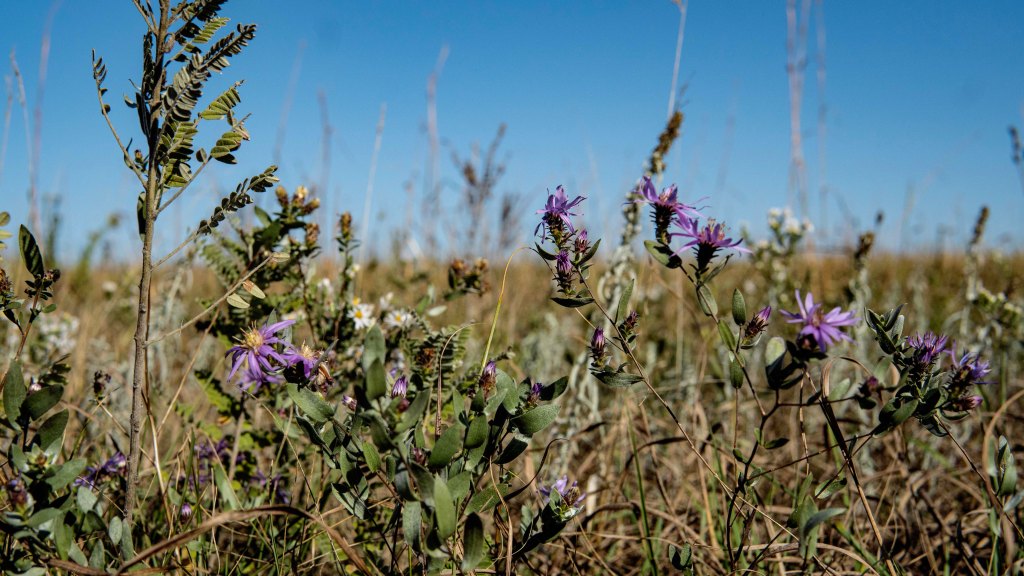
Remember this settlement is temporary- these towns, streets, and buildings. Less than 200 years ago all of this land was Prairie with trees only lining the streams and rivers. Prairies are immensely diverse communities of plants, animals, and soils. The prairie plant’s roots reach more than 15 feet into the soil. Because of these deep roots, the prairies are able to thrive through disturbances like fire, drought, cold winters, and grazing bison. The prairie depends on these disturbances, although excessive disturbance is detrimental to the community.
As a result of colonial violence, only 1% of the original Prairie is left today. There are many successful efforts to protect remaining prairies and to restore lost prairies. It takes a lot of work to undo the violence of industrial agriculture and to create the conditions for the soil to heal, and for the plants, small mammals, insects, and the birds to return.The Prairie can teach us a lot about being in a healthy community, and because of its destruction, absence, and efforts of restoration, prairies can teach us how to heal.
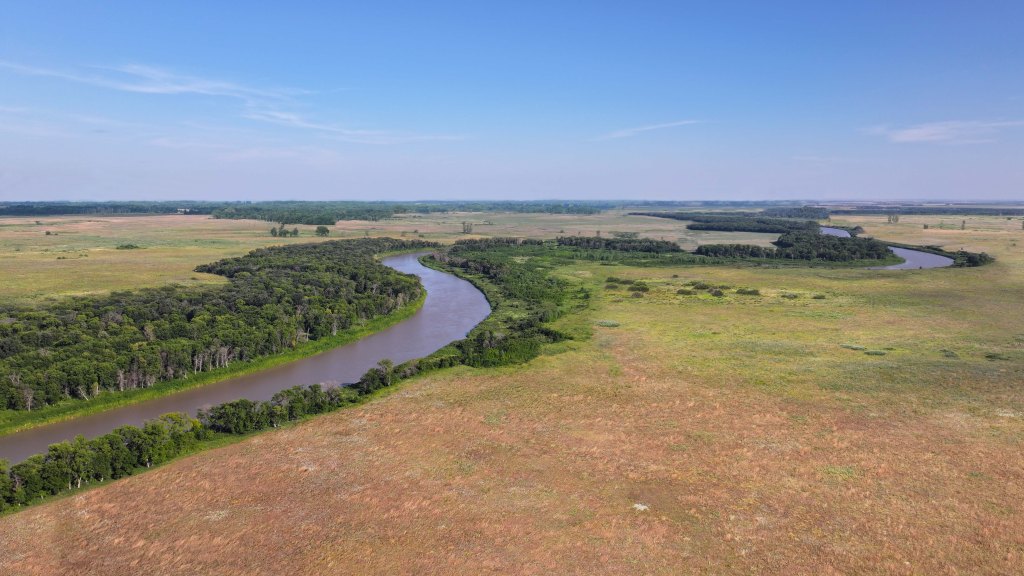
Vision of the Red River’s decolonized future
Less than a year ago, I returned to Moorhead after 8 years of being gone. I’ve been fortunate to have diverse experiences in living in community. I’ve lived in communities while unhoused on the west coast, squatting in the woods in Texas, and fighting pipelines in Minnesota. Starting in late 2020, I lived in community with literally hundreds of people while living at the Line 3 resistance camps for almost three years. For the most part, I didn’t choose the community I worked with to build our camp. I learned so much about taking care of each other as a means of survival as well as navigating conflict and choosing battles. My awareness and values regarding community was created and nurtured by being in community with Native People and others. I learned that healthy relationships are foundational to any successful movement.
I continue to learn, read, and listen to podcasts about living in community, decolonization, navigating conflict, and restorative justice. We know the CIA disrupts movements by fucking with people’s trust in each other (ex: COINTELPRO disrupting Black Panthers, AIM, and pretty much any resistance group). It’s evident that a strong community is in itself a major threat to the government and status quo and therefore absolutely vital to our liberation.
Since Line 3, I have been super fortunate to learn about other solidarity movements around Turtle Island and in Hawaii. After Line 3 I was involved with Camp Nenookaasi and anti-ICE patrols in Minneapolis. I’ve also recently gotten to visit a community in Cordova, Alaska who, through strong and vast solidarity and a deprioritization of politics, have been continuously successful in protecting their land and water. The solidarity within the community felt tangible everywhere I went. We stayed with Native People who talked about how everyone in Cordova had similar goals regarding the land. The majority of people there, Native and non-Native, rely on the land and have successfully fought many fights against extraction.
In Hawaii, I got to visit a group (HuiMAU) who are acquiring plantation houses and land to grow their traditional food on, planting food forests, and learning traditional ways of growing food and healing the soil from the abuses of colonialism. The way Noʻeau talked about what they were learning from healing the soil and growing their food had me tearing up thinking about the potential for our communities to change. The people there have to work to learn the old ways of growing food and even then, it takes time- generations for the food and the soil to heal from colonial abuse and produce the amount and quality of food they are supposed to. It had me thinking of the things that I’ve heard people say here regarding urgency. Urgency is ineffective in organizing community. We need to be comfortable with how much time it takes to heal and unlearn abusive and/or negligent ways of relating to each other.
Dakota author, professor, and activist Waziyatawin, Ph.D. said,
“One of the most insidious aspects of colonization is that our own vision of what is possible begins to become constrained and so we cannot imagine a liberated future. So resistance in the mind means shedding those parameters that have been set by the colonizers and beginning to imagine what a liberated future would be and then working to try and enact that.”
We cannot undo the damage done by colonialism- not on the land, with each other, or in ourselves. We can only move forward in our thinking, our understanding, our care, and our actions. We have the power and responsibility to decolonize ourselves, our relationships, and the land. It will take a lot of time and work to heal the land and restore the prairies. It takes a lot of time and work to unlearn and shift the paradigm in ourselves and our society from one that is complicit with colonial violence to one that cannot help but to fight for liberation and justice. I hope you will ask yourself how you can help heal and care for your piece of this world- how are you building and maintaining community? What does liberation and justice look like? What is your relationship with the land here? Do you know what this land would look like if decolonized? What would you and your relationships look like if they were decolonized?
My hope for folks in Fargo-Moorhead is that we will all be more kind to each other, do away with purity politics, hold each other accountable and be accountable, and navigate conflict with curiosity and honesty. Also folks need to stop being so mean and critical of each other, damn.
“Embrace diversity. Unite—
Or be divided, robbed,
ruled, killed
By those who see you as prey. Embrace diversity
Or be destroyed.”
― Octavia E. Butler, Parable of the Sower